
Why Totango
Is Now Odie
A letter from Keith Frankel, CEO of Odie (formerly Totango)

Today, we announced that Totango has become Odie.
For more than 15 years, Totango earned a leadership place amongst Customer Success platforms, a category that we believe has genuinely mattered. Hundreds of enterprise customers, thousands of users, and billions of dollars of end customer revenue have been entrusted to Totango over those years.
Choosing to incubate an entirely new business inside of a successful legacy one was a challenging decision. We’re proud of the leadership position that Totango earned, but ultimately we’re not sentimental about it. The fact is, the world has changed. The job at hand is different. And the humans tasked with completing the work need something that didn’t exist before.
Odie is our answer to that shifting need.
Getting to this day took over a year of hard work, and I believe that moment warrants a behind-the-scenes look at what led us to this point, where we intend to go from here, and more importantly, how what we’re seeing from Odie customers has convinced us that this was the right decision.
How we got here…
Long before I joined the company in 2025, Totango and Gainsight had already thoroughly established the idea that customer-facing teams deserved a discipline of their own – their own practices, their own leaders, and their own tech stacks.
Catalyst came later. An early-stage startup that became a venture darling in the early-2020s, Catalyst heralded a perspective the market was primed to hear: existing customers are the most efficient growth lever, and the entire company – spearheaded by the Customer Success team – should be organized around that idea. They called this customer-led growth. They had the right message at the right time, and in 2024 Totango and Catalyst decided to merge.
When I arrived later after the acquisition of my prior predictive AI company, Parative, I was excited to inherit both of those histories. What I wasn’t aware of at the time was just how much the ground was going to begin moving underneath them.
The dawn of a new day…
Countless words have been spilled related to the general impact of AI. I won’t belabor the point by adding to that here. What I will say is this: Two years ago, the primary focus of conversations I had with post-sales leaders was about org. design. What should our coverage model be? Who owns renewal and expansion? How do we comp on CSQLs? Those conversations have ceased almost entirely. What leaders are focused on now is how they supplement their teams with AI to get more efficiency, more productivity, and lower operating cost.
More is being asked of customer-facing teams than ever before, and fewer people are being employed to do it. Every leader I talk to is being asked to cover more customers, protect more revenue, and grow more accounts with a smaller team.
And these shifts have exposed a new vulnerability in the software that we all spent years building: in the ongoing evaluation around build vs. buy, build is now a legitimate alternative to buy.
A brief detour: the problem with traditional CRM-style Customer Success Platforms…
At its core, every Customer Success Platform is essentially a secondary CRM with better manners. Objects, fields, attributes, rules, dashboards, playbooks – arranged for post-sales teams instead of sales teams, and sold on the premise that its particular arrangement made it something other than just another CRM.
During the SaaS boom, that premise held up. Capital was cheap, budgets were generous, and a system that made a team feel organized was sufficient to justify a subscription.
That era is over. CFOs no longer approve redundant systems that can't demonstrate return, and the market has voted with unusual clarity: the large majority of companies that churn from a traditional CSP never buy another one. Not Totango’s. Not our competitors’. Nobody’s. When a category loses most of its customers to nothing at all, the category is the problem. And that problem stems from the core design philosophy of the platforms:
The administrative burden is enormous.
Dozens of objects, hundreds of fields, and a permanent part-time job for whoever inherits the admin seat.
The systems are static and pre-determined.
If nobody writes the conditional logic, nothing happens. It can only surface what someone already thought to look for or action what someone already decided made sense.
It requires human interpretation of everything.
The system reports table-based data in charts of various formats and colors. A human has to manually decide what all of that means, day in and day out.
It mistook task management for the work.
The actual job resides in a conversation, a judgment call, a clever workaround, and a favor called in across departments. None of that lives inside a formal task object, but the system was hell-bent on measuring “activity” that humans were forced to log rather than the value they were intended to create. Task fatigue became the modus operandi.
In all likelihood, customer teams might have continued tolerating all of the shortcomings of the last generation of tooling I just described. Mediocre solutions survive a long time when there's no alternative, and for most of the last decade, there wasn't one.
Then AI arrived, reached genuine readiness, and the entire paradigm around how companies buy and use technology moved with it.
AI has changed our perception of what was possible…
SaaS was always a lowest-common-denominator bargain. You bought a product built for the average of a thousand companies and adapted your process to fit it, because building something purpose-made for how your team actually works was too time intensive and expensive to continually justify. AI has legitimately collapsed that math. Specialized tooling, built for one team's specific use case, is quickly becoming something that a capable operator can produce at the speed of prompt.
So teams are building… or at least spending a whole lot of time talking about it. And nearly every SaaS vendor in the market is working to convince them not to – that the maintenance burden is too high, that they'll regret it, that they should buy from specialists instead.
They're wrong. It would be foolish not to build right now when borderline-magical technology has democratized access almost entirely. The question isn’t whether or not a team should build their own tools. The questions are what exactly they should build, how to make what they build meaningfully better for their use cases, and how the things they build and the things they buy fit neatly into a single, unified ecosystem.
That’s inevitably where all of this is going, and it’s the world we want to be part of. But for the high-stakes, high-nuance world of post-sales in which critical revenue-bearing relationships are often determined by the interaction between two humans, the bar for what we build must be uniquely high and uniquely human.
The path to customer-grade AI…
The simple reality is that the bar for AI working in front of enterprise customers is higher than the bar for AI almost anywhere else in your business.
For customer-facing teams, then, the goal is not about more AI; it’s about better AI. And that bar is not cleared with more data or a semantic layer on top of that data (trust me, we’ve tried exhaustively). It’s cleared by injecting that AI with human perspective and experience.
The individual history of each customer. The personalities in the room. What was promised two years ago by someone who has since left. Which approach worked the last time this happened with a similar customer. What upcoming update from the last internal roadmap review will alleviate a customer’s pain. That knowledge doesn't live in your systems; it lives in your people, in their conversations, and within the conversations you have with customers. In fact, research estimates that more than 80% of company tribal knowledge is tacit, existing undocumented in the minds and memories of its people.
Unlocking customer-grade AI is a context problem, one you solve by teaching it what your best humans know.
And any general-purpose AI that doesn't have that context should not be trusted in front of your revenue-bearing relationships.
That’s why we built Odie.
of company tribal knowledge is tacit — undocumented, in the minds and memories of its people.
Introducing Odie: customer intelligence for post-sales teams and their agents…
At its core, Odie is a Customer Knowledge Engine designed to give post-sales teams access to customer-grade AI that is demonstrably smarter, more human, and highly token efficient – whether they build those agents or we do it for them.
Odie captures what your best humans know about your company and customers – the tribal knowledge, the relationship histories, the reasoning your best people apply without ever documenting it – and combines it with ongoing AI analysis of your customer data. The result is a living narrative of each customer, each employee, and your business that maintain themselves as the underlying context changes.
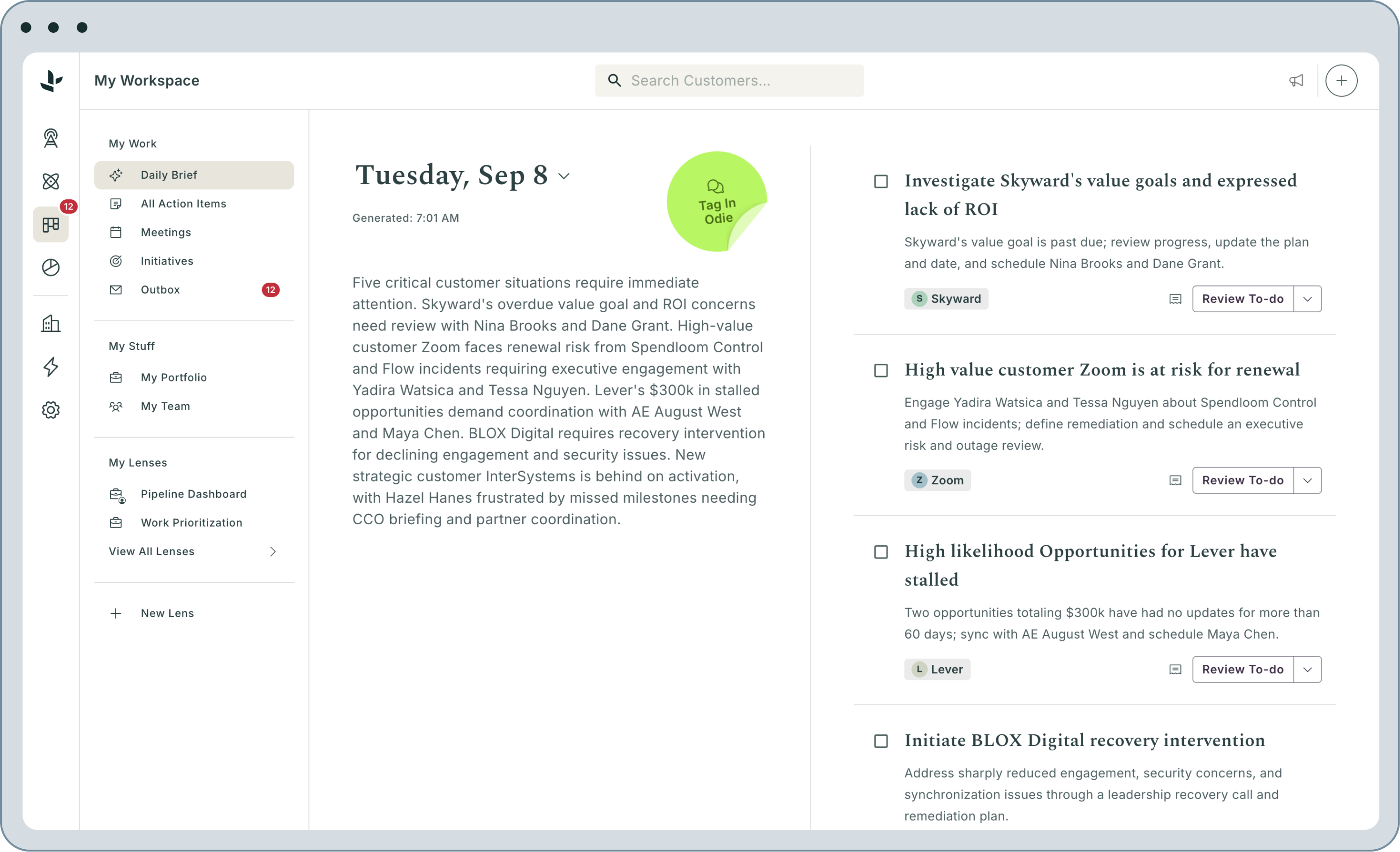
Odie then puts that context wherever the work happens, regardless of what you connect to Odie’s MCP or which of Odie’s native add-on tools you want to use. Power your agents. Power our agents. Or power our optional guided workspace experience, the Customer Operating System, a modern agentic alternative to the traditional Customer Success Platform.
So what happens next?...
Odie is only possible because it didn’t start on a blank whiteboard. It was derived over the course of fifteen years inside enterprise post-sales organizations. Real enterprise customers, real post-sales operating models, real customer hierarchies, and nearly two decades of learning how it all connects. And for that, we owe a wealth of gratitude to the long, storied histories of Totango, Catalyst, the employees that built those legacies, and the customers that supported them along the way.
Legacy Totango or Catalyst customer?
If you're currently a legacy Totango or Catalyst customer: nothing about your account changes today. Same contract, same pricing, same product, same people. We'll show you what's new when you're ready to see it, but for now it will be business as usual.
Already using Odie?
If you’re already successfully using Odie, we can’t wait to show you what else is just around the corner.